
FEATURE | By Kit Stolz
Drawn to the Truth
Ojai-raised comics journalist Shay Mirk uses zines, reporting, and community to tell the stories powerful institutions would rather keep off the page. By Kit Stolz
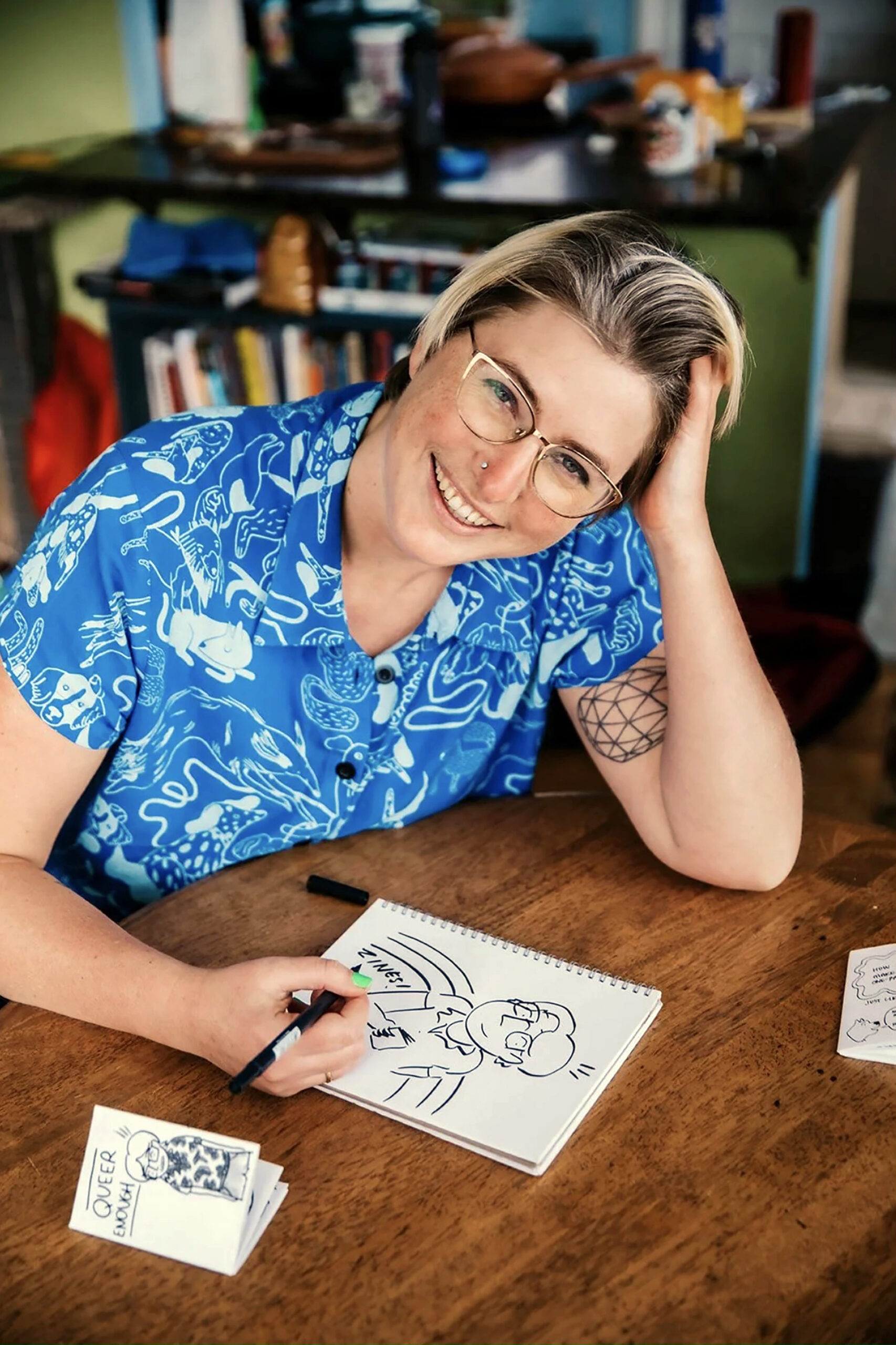
Shay Mirk at work
If you have orbited on this earth more than 40 times around the sun, you may not have heard of — or have hardly seen — “comics journalism, “a form of non-fiction reporting in graphic form.
Or you may have heard of these forms — such as ‘zines — but not really seen them on the page. You might know of Archie and Veronica, but have missed the epochal “Maus,” the graphic novel of the Holocaust by Art Spiegelman. First published in 1986, it is now considered a classic. Perhaps you also overlooked the ground-breaking comics journalism about the Mideast by Joe Sacco, collected as “Palestine,” which won the American Book Award in 1996.
If this is the case, likely you will also not know the work of Sarah Shay Mirk, the author and editor of the stunning non-fiction comic “Guantanamo Voices.” Published in 2020, this is a hard-as-nails factual history as told mostly in quotes from interrogators, lawyers, officers and detainees inside the prison at Guantánamo Bay, illustrated by artists from around the world.
After working as a reporter, cartoonist, writer, and editor for many years, and after having published six books, Mirk appears to be the most ambitious, innovative, and published journalist to have emerged from Ojai this century.
So why don’t more Ojaians know of her or her work?
“I hate telling you this,” Mirk said, to the aging reporter for the OQ. “But that is a generational thing.”
Mirk speaks gently, but with a blunt clarity that shines through the niceties.
“I do run up against this with older readers, people who grew up thinking of comics as newspaper strips,” Mirk adds. “I would say younger audiences, people about my age, 40 or younger, have grown up with more of a culture of nonfiction comics and manga. A lot of people have come to understand that comics can express a wide range of emotions. I think if you talk to younger people, I think you will find they are reading a lot of comics, on apps, on the web, in book stores, and magazines, and there’s just a much broader range of what’s available than when you were a kid.”
Mirk grew up in Ojai and gives the Mirk family and the town’s creative spirits (such as at the Ojai Youth Foundation) plaudits for encouraging creativity. A special shout-out goes to an older brother, Dan Mirk, who got his start in humor writing for The Onion, and has gone on to become a comedy writer and television showrunner.
“I grew up drawing, which is something all kids do, and at some point, a lot of people get told that they’re doing it wrong,” Mirk said. “My brother and I never got that message and just kept drawing. In high school, I published little comics, with photocopying, and in college, I ran a student comics publication.”
FROM ZINE TO BOOK
From the start, Mirk created non-fiction comics, often on touchy subjects such as politics, even when the attention that followed made young Mirk a little uncomfortable.
“When I was in high school, the U.S. invaded Iraq and Afghanistan,” Mirk said. “There was a really small protest (at Nordhoff), of like four people. I wanted to join the protest, but I was too shy. I wanted to like, speak up, but I didn’t want everybody looking at me.”
Even now — after becoming a full-fledged reporter, writer, publisher, and instructor at a teaching press she co-founded, Crucial Comix — Mirk continues to create and publish zines, as often as once a day. Mirk even constructed a cart to promote and swap and give zines away at events in Portland.
On a Patreon site, Mirk hosts a “Zine of the Month,” featuring zines from a wide variety of contributors. Many of those contributors, often from far-flung places around the world, got their start using the blank template for zines on Mirk’s site. Although many of Mirk’s zines are personal and often humorous (such as “Why Did I Think I Was Straight?”), others are enormously informative, the product of considerable research and reflection, such as “Get Ready: A Gentle Guide to Emergency Preparedness and Building a Go Bag.”
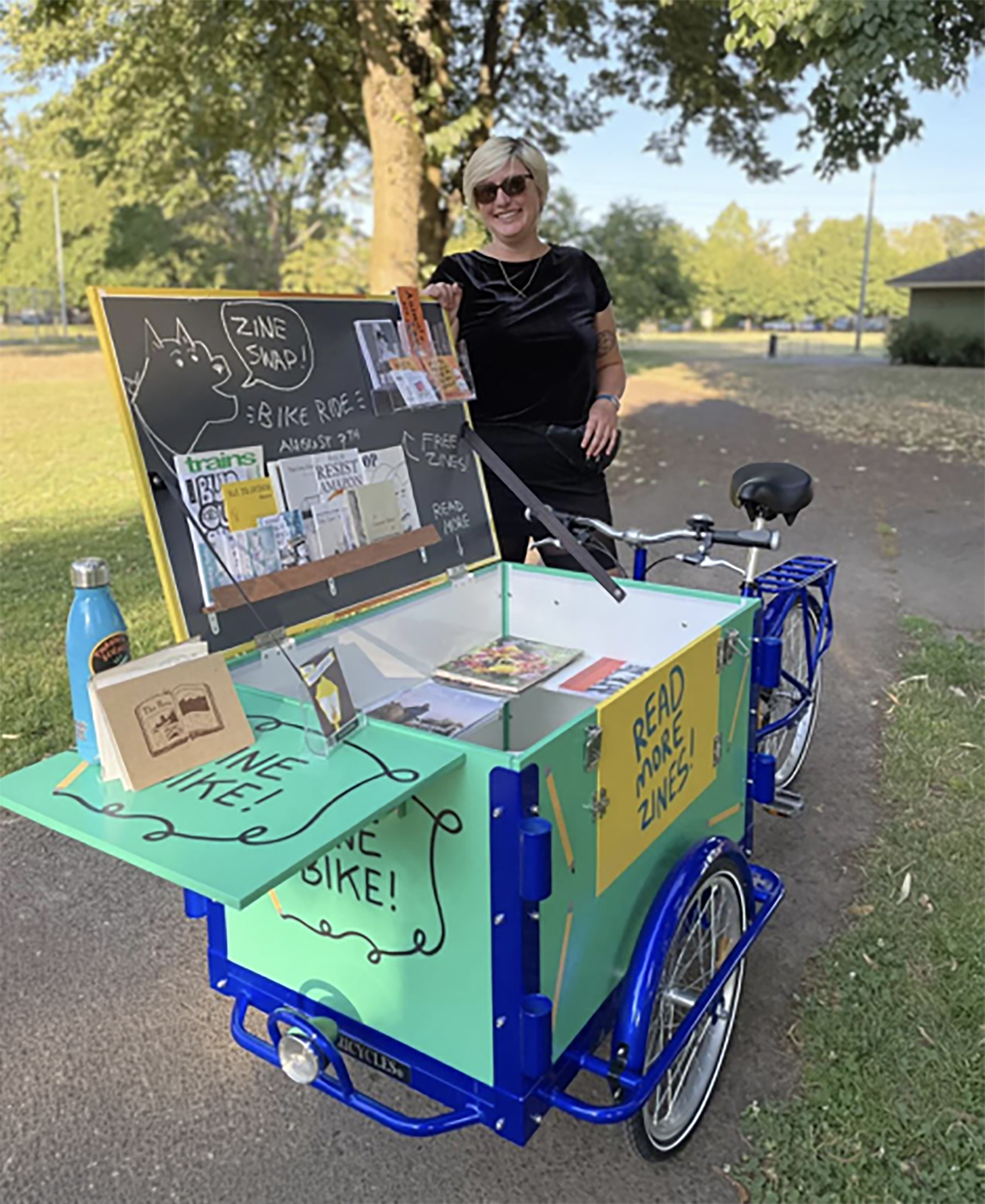 In this free-to-download zine, Mirk shows readers how to assemble a “go bag” for disasters. However necessary, an individual action such as this is not nearly enough to keep a person safe in a time, Mirk believes, when whole communities face enormous disasters such as the Thomas Fire.
“Because I grew up in Ojai, I’m always worried about fire and flood,” Mirk said. “Now I live in Portland, and I’m always worried about earthquakes. Some friends and I formed a little emergency preparedness group a couple of years ago to make go-bags and meet up once a week, but a lot of our conversations were really about how many Americans have a desire to kind of buy their way out of this problem. What really makes us safer are the social networks we have built — our relationships with our neighbors and our community. Being able to trust the people around you.”
Trust and the need to find your community — the people who understand you — track like well-worn paths through Mirk’s creative life. At Grinnell College in the Midwest, Mirk found a community supportive of comics and zines, but knew that wasn’t enough. Even before graduating from college, Mirk — who in recent years has come out as non-binary — knew exactly where they wanted to work, at The Stranger, a well-known and feisty weekly in Seattle.
“I had no connections to Seattle, but I wanted to work for an alt weekly, because I wanted to have a voice,” Mirk said. “I didn’t want to work for the AP or television news. I wanted to work where I could be a writer and bring my perspective.”
Mirk admits to harassing The Stranger for the job.
“I’m like … this is where I want to work, you are the people I want to work with, please let me come work for you for free,” was Mirk’s pitch. At The Stranger and later at the Portland Mercury, Mirk worked to develop reporting skills, focusing on City Hall issues and interesting locals. After developing their reporting skills at The Stranger and at the Portland Mercury, also an alt weekly, Mirk worked for several years as an editor and writer at the feminist magazine Bitch, and then as an editor and artist for a prominent comics magazine called The Nib.
BECOMING AN AUTHOR
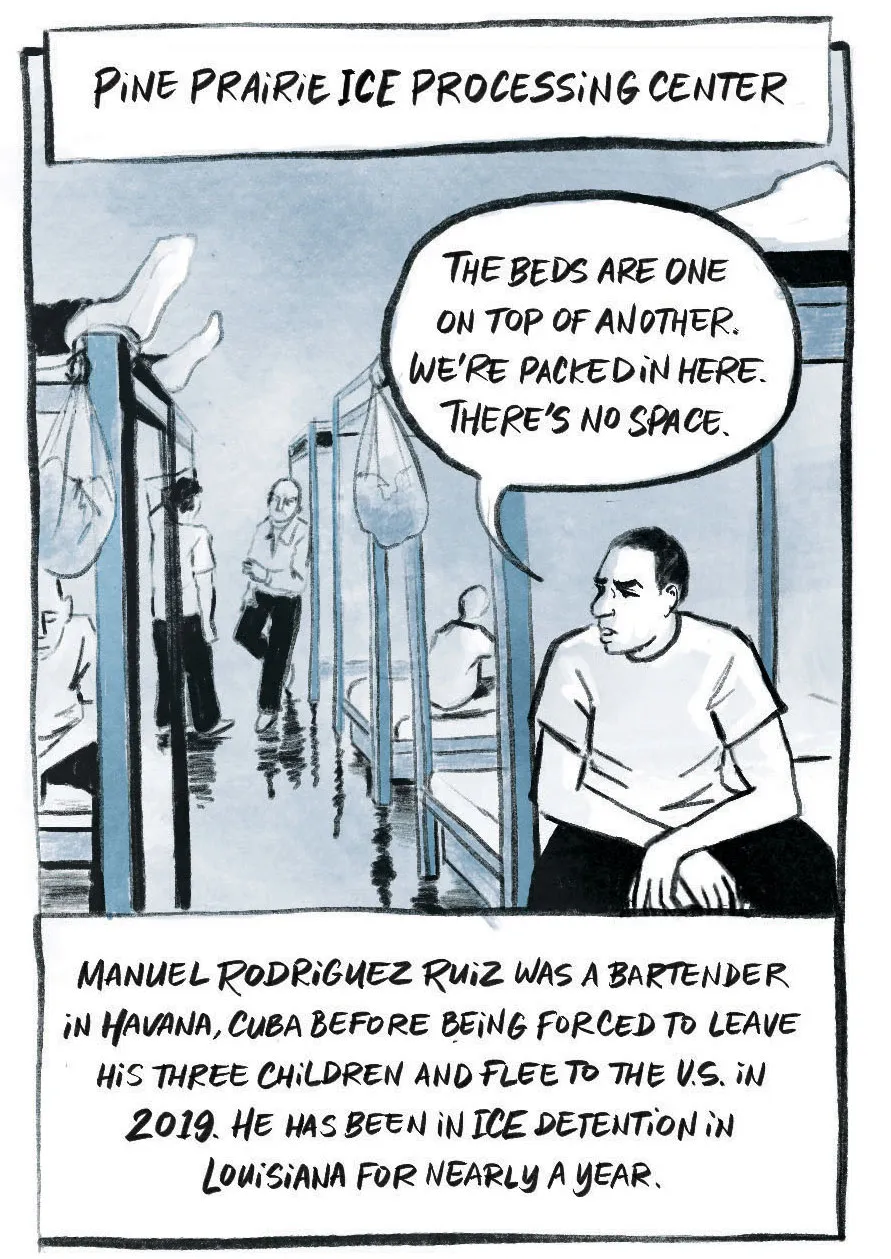
Comic journalism on Guántanamo Bay
But it was through a zine community that Mirk stumbled upon what may be her biggest story to date, an international saga. In Portland in 2008, Mirk met a former Michigan National Guard member named Chris Arendt who was working on an anti-war zine about the time Arendt spent as a prison guard at the notorious U.S. base and prison encampment in Guantánamo Bay, Cuba. Mirk and Arendt became friends, and through Arendt’s connections, Mirk began a long-term reporting project on the infamous prison for alleged terrorists and “detainees.”
A decade later, In 2019, Mirk applied to go on a rare media tour of the facility. Scenes from that often surrealistic tour became the start and the conclusion of an uncannily beautiful and haunting history of the prison they published, titled “Guantánamo Voices.”
It’s an artful but hard-hitting book, edited and largely written by Mirk, and drawn by artists from around the world, employing a gorgeous color scheme characteristic of the tropical sunsets of Guantánamo Bay. It’s a beautiful telling of an ugly story, intended to lure people into looking at the hard truths — drawn largely from testimony — about what happened there, and is happening still.
“Basically everything we’re experiencing now around immigration, mass arrests of people for no reason, detention without end, holding people without trial, racial profiling and deporting people to countries that they’re not from — all that happened with Guantánamo,” Mirk said. “All that happened 20 years ago, and people who raised alarms about it were imprisoned. I feel as if the U.S. government did a really good job of not letting that narrative get out and selling a narrative that this is what we need to do to protect American lives.”
In 2025, Mirk followed up with another collaborative effort, an encyclopedic how-to book called “Making Nonfiction Comics,” working closely with another cartoonist and editor, Eleri Harris from Australia. As with “Guantánamo Voices,” the book serves as both a history of the form and an up-to-date guide, including interviews and panels from nonfiction comic artists from around the world. It features legendary names in the field, such as Joe Sacco, as well as many other less-well-known nonfiction reporters and artists, as for example Susie Cagle of The Guardian.
Along the way, Mirk consciously worked to create a community that will support comic art and reporting in Portland. Social media can be useful, Mirk thinks, for audiences to find comic artists, and for comic artists to find audiences and other writers, but Mirk has found that outlets such as Instagram can’t be trusted long-term.
“The point of Instagram is to make money for billionaires,” Mirk said. “I think it’s really important for everyone to have a way to publish their work that does not make money for billionaires. A place where you control the platform, and a place where artists can publish work that is political, work that’s about sexuality, that shows human bodies, and where the rules about what can and cannot be published won’t change overnight.”
BECOMING a publisher & instructor
This led in 2014 to Mirk and collaborators launching Crucial Comix, a “teaching press” that publishes zines and comics, while hosting classes on the craft and art of the form.
Community, in Mirk’s experience, offers a kind of freedom that can’t be taken away. In the guide to nonfiction comics, Mirk offers readers an extraordinary level of support and personal transparency, right down to the numbers involved in publishing six books. They included how long it took to write and illustrate each one, the publisher, the number of copies sold, the advance, and whether the project required an agent and a proposal. It’s a look-at-this-you-can-do-it-too book intended to empower nonfiction artists and writers — a manual for a 21st century form of reporting.
This makes sense to Mirk financially, but it also fits the nature of comics.
“One thing you can do with comics is that an illustration can express a lot of emotion that’s hard to put into words. It can really be playful, like a piece I made about getting diagnosed with a genetic condition that puts me at a higher risk for certain cancers, and debating whether to get my uterus removed or not,” Mirk said. “Real life is never one note. Even in the saddest moments, there’s dark humor or silliness that can come through.”
That mix of tones doesn’t always endure in media. Mirk says that when the billionaire-backed media company that had funded The Nib decided after almost a decade to abruptly cut funding, an entire ecosystem of cartoonists, editors, and writers went dark.
“It is frustrating that the people with the money have so little vision, and the rest of us pay the price for it,” Mirk said. “Basically I have learned to trust no institution. I don’t want to try to be a tenured professor at a school. I don’t want a staff job on a magazine. I feel like the bottom can fall out of any industry at any time.”
Mirk argues that creators too often fail to create the creative life they want for themselves.
“I get frustrated when people are wishy-washy about the value of their work. It actually makes me angry, because nobody else is going to advocate for you,” Mirk said. “You have to advocate for yourself. And that’s what I do. I feel I have to be kind of ravenous in going after the freedom and ability to do what I want. It’s really difficult to do under capitalism, but that’s what I’ve always pursued, is just the freedom to create what I want.”
Leave A Comment