
FEATURE | By Jennie Prebor
Light, Land & The Long View
This spring, the Ojai Valley Museum welcomes the return of “Ojai Mystique,” on view from April 17 through August 9, 2026.
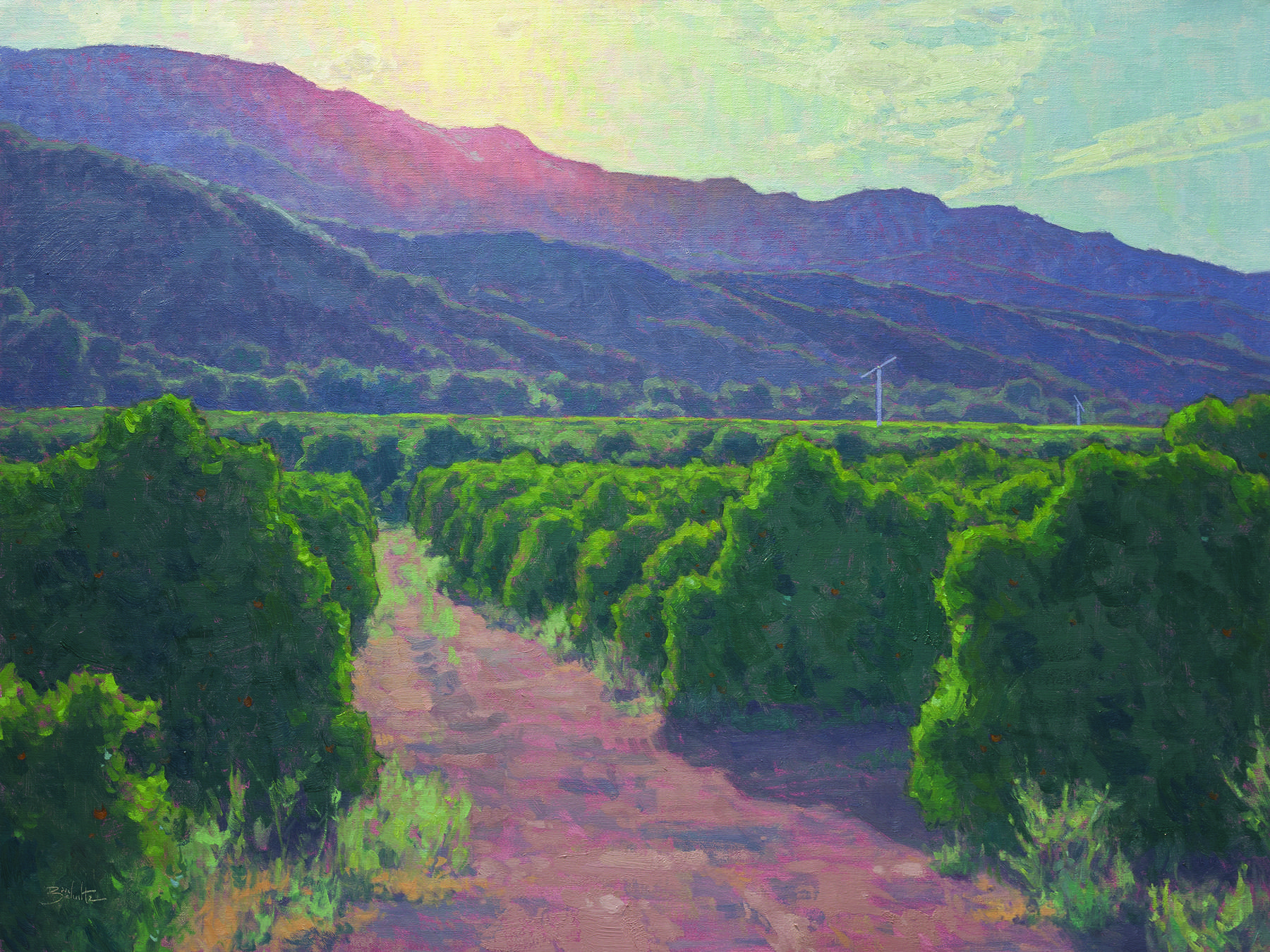
Dan Schultz-Sunlit Orchards-30×40-Oil on Linen Panel
First presented in late 2023, the exhibition quickly became one of the Museum’s most beloved offerings — one people lingered with, returned to and talked about. With this second iteration, the intention is that “Ojai Mystique” offers a recurring moment to pause and look closely at how artists continue to respond to the Valley, its light, its quietly powerful terrain and its singular atmosphere.
Artists have been coming to Ojai for more than a century, drawn by a particular combination of land, light, and atmosphere that is hard to define and impossible to ignore. Framed by mountains and open skies, the Valley feels at once intimate and expansive. A cloud passes, the wind shifts, the hour changes and suddenly everything looks different. Ojai’s golden hours and pink moments have been written about endlessly, but they remain compelling, especially for painters willing to slow down and really see.
“Ojai Mystique” enters this long lineage with fresh eyes.
While the exhibition centers on paintings of Ojai, it is intentionally invitational, bringing together artists from both within the Valley and well beyond. As with the inaugural exhibition, it is curated by Ojai-based artists Jennifer Moses and Dan Schultz, whose deep familiarity with the Valley’s rhythms — its moods, seasons, and surprises — grounds the project.
Each of the 19 invited artists was asked to create two works inspired by time spent in Ojai: a large master painting paired with a smaller companion piece. Seen together, these pairings feel conversational. They allow space for both immediacy and reflection, for bold statements and quieter afterthoughts. It’s a structure that mirrors how artists come to know a place — not in a single encounter, but through repeated looking and gradual understanding. Curator Dan Schultz sees “Ojai Mystique” as a way of documenting the Ojai Valley at this time in history. “Years from now,” Schultz says, “people may look through our exhibition catalog and see the beauty of this time and place as captured by these artists. The paintings in this exhibition may become important pieces in their bodies of work.”
“As curators, we bring different perspectives to the process, and our ongoing exchange helps shape an exhibition that feels both cohesive and expansive. It is a great pleasure to share these works with our community,” says Schultz.
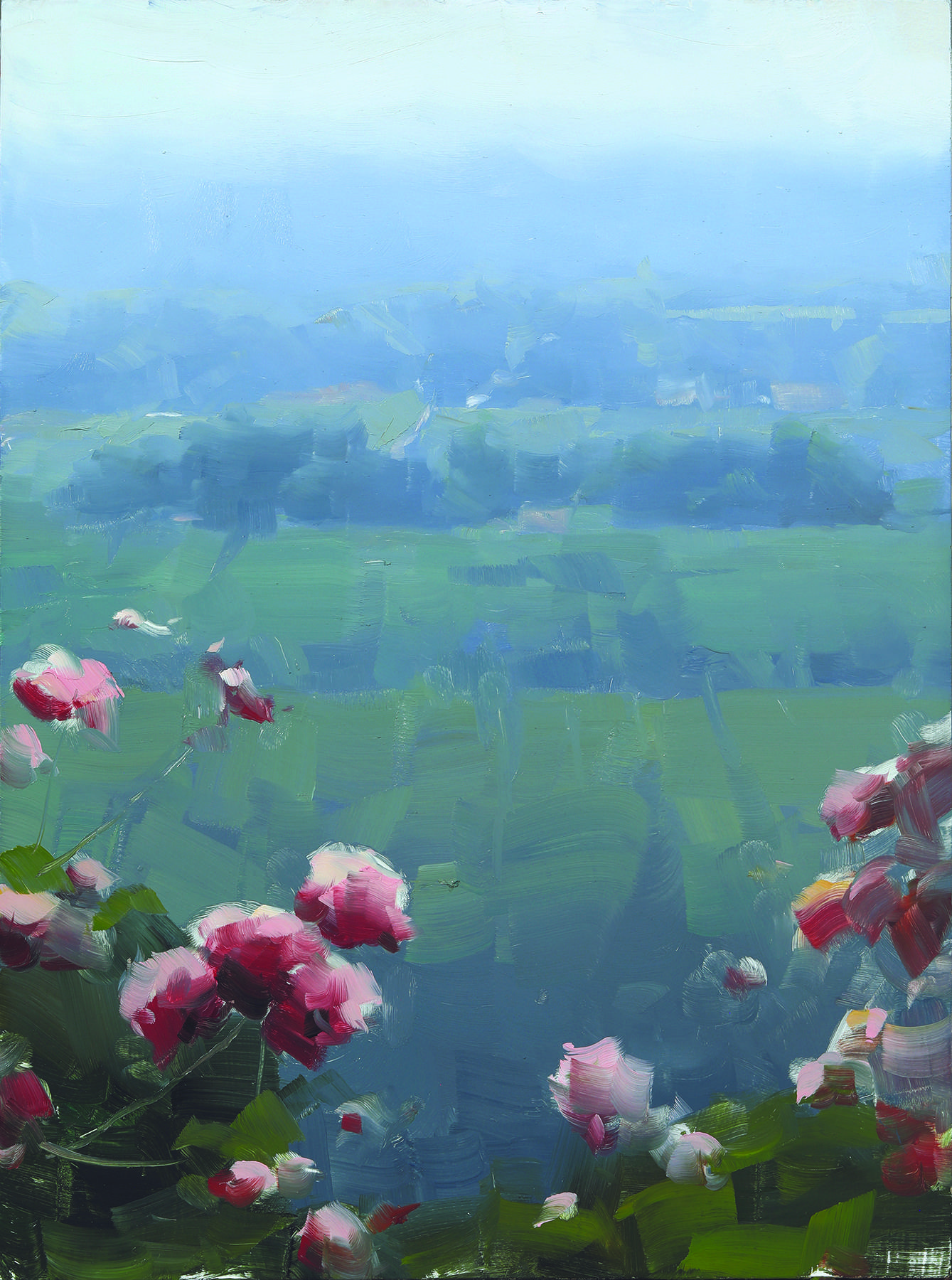
Dave Santillanes-The Ojai Valley, Study-9×12-Oil
The practice of painting directly from nature has deep roots in California, reaching back to the 1850s and flourishing through the 1930s in what many historians describe as the halcyon years of the plein air movement. Artists arriving during and after the Gold Rush encountered a landscape unlike anything they had known; vast, largely undeveloped, and suffused with a luminous, ever-changing light. Working outdoors, they sought to capture fleeting moments such as the movement of clouds, the shifting color of hillsides, the elements that make California feel unmistakably itself.
Over time, this approach produced a voluminous and deeply moving body of work now known as California Impressionism. These paintings were widely exhibited and collected, often purchased by prosperous tourists traveling west from far-flung parts of the country, drawn by California’s promise of beauty, health, and reinvention. Artists gravitated toward places that embodied promise, such as coastal enclaves, foothills and inland valleys where nature felt restorative and sublime. Ojai, with its distinctive geography and sense of retreat, naturally became part of this artistic circuit, much as it remains today.
That long period of impressionistic interpretation came to an abrupt halt with the Great Depression, which altered both the economic and psychological climate that had sustained the genre. Patronage declined, tourism slowed, and artistic priorities shifted. By the mid-twentieth century, plein air painting, once central to California’s artistic identity, had fallen out of favor, eclipsed by modernist and abstract movements.
Its revival began quietly in the 1970s, led by scholars and curators who recognized that something essential had been overlooked. Landmark exhibitions such as “LA Painters of the Nineteen Twenties” (Pomona College, 1972) and “California Design in 1910” (Pasadena Center, 1974), helped reposition plein air painting not as nostalgia, but a as foundational chapter in California’s visual history — one worthy of renewed attention.
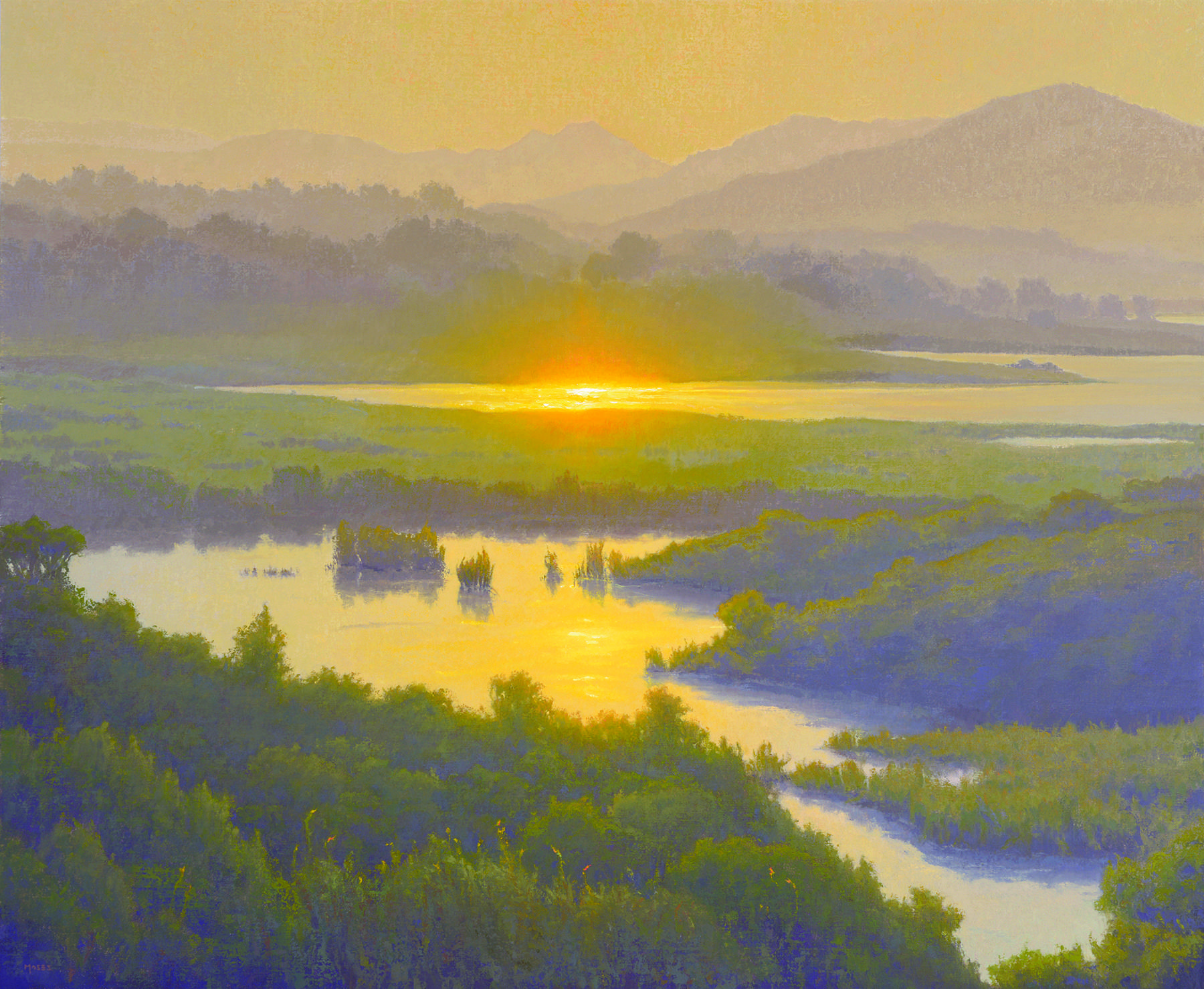
Jennifer Moses-Sun Gazing-36×44-Oil on Linen
Ojai’s own history as an artistic destination stretches back to the early twentieth century, when painters such as Edgar Payne, William Wendt, and Elmer and Marion Wachtel traveled to the Valley to work directly from nature. Their paintings helped establish Ojai as a place of creative possibility, celebrated for its dramatic topography and singular light. “Ojai Mystique” acknowledges that legacy, but it is firmly rooted in the present.
“Ojai Mystique” focuses on how artists translate their lived experiences of place into finished work. While some begin by painting directly in the landscape and others work through sketches, photographs, color notes, written impressions, or reflection, each practice is distinct and guided by memory, intuition, and personal sensibility. What unites the artists is a shared attentiveness to the Valley’s rhythms, light, and emotional presence, as opposed to a common methodology. Each artist’s practice is unique.
Rooted in the values of California’s plein air legacy of direct observation, sensitivity to atmosphere, and respect for the landscape as a living presence — the exhibition embraces a wide range of contemporary approaches. Together, the works form a layered portrait of Ojai that honors history while affirming landscape painting as a vital, evolving form.
The time of the year is a defining element of this edition of “Ojai Mystique.” With roughly 12 months to work, many artists explored the Valley across multiple seasons. For the 2023 exhibition, the artists painted primarily in the spring following an unseasonably wet winter. The 2026 works reflect late summer, fall, and winter — drier palettes, subtler tonal shifts, and quieter moods that reveal a different side of the Valley.
The invitational includes artists John Cosby,
Steven Curry, Carolyn Lord, Kim Lordier,
Jennifer Moses, Charles Muench, John Nava,
Michael Obermeyer, Jesse Powell, Ian Roberts, Ray Roberts, Dave Santillanes, Dan Schultz, Frank Serrano, W. Jason Situ, Alexey Steele,
Sarah Vedder, Anne Ward, and Wendy Wirth.
These artists were given maps of the region and freedom to explore. Some returned to familiar sites; others encountered Ojai for the first time. Paintings emerged from across the Valley, from Casitas Springs to Lake Casitas, to the historic downtown, to the East End and Upper Ojai — forming an organic, collective portrait shaped by individual journeys.
Much like the visitors who once carried California landscapes home in the late 19th and early 20th centuries, today’s audiences will encounter Ojai through the eyes of artists who have slowed down and paid attention. Here, the landscape painting tradition isn’t nostalgic. It’s alive.
“Ultimately,” curator Jennifer Moses reflects, “‘Ojai Mystique’ is about relationships — between artists and the landscape, between the paintings themselves, and between the exhibition and its audience. Imagining how visitors will move through the space and connect with the work is what makes the process so meaningful.”
“Ojai Mystique” continues that conversation, inviting today’s artists to engage with the Valley not just as a subject, but as a living part of Ojai’s cultural story. Walking through “Ojai Mystique,” visitors encounter the Valley not as a fixed image, but as a living presence — observed, revisited, and translated though many eyes. These paintings slow time. They ask us to notice how a shadow lengthens, how color thins in winter light, how the land quietly asserts itself. In doing so, the exhibition reminds us that Ojai’s mystique isn’t something inherited or preserved — it’s something continually made, through attention, patience, and the act of looking again.
“Ojai Mystique” is on view at the Ojai Valley Museum from April 17 to August 9, 2026 with related programs and events scheduled throughout the exhibition.
Founded in 1966, the Ojai Valley Museum has served as a steward of the region’s art, history, and cultural life. Housed in the former St. Thomas Aquinas Chapel near the center of town, the Museum presents exhibitions and programs that explore what makes the Valley distinctive — its landscape, its people, and the creative spirit that has shaped both. By placing contemporary exhibitions alongside local history, the Museum creates a space where past and present meet.
Leave A Comment