
FEATURE | By Bret Bradigan
Ojai Diamonds
The Hidden Quartz Crystals of Nordhoff Ridge
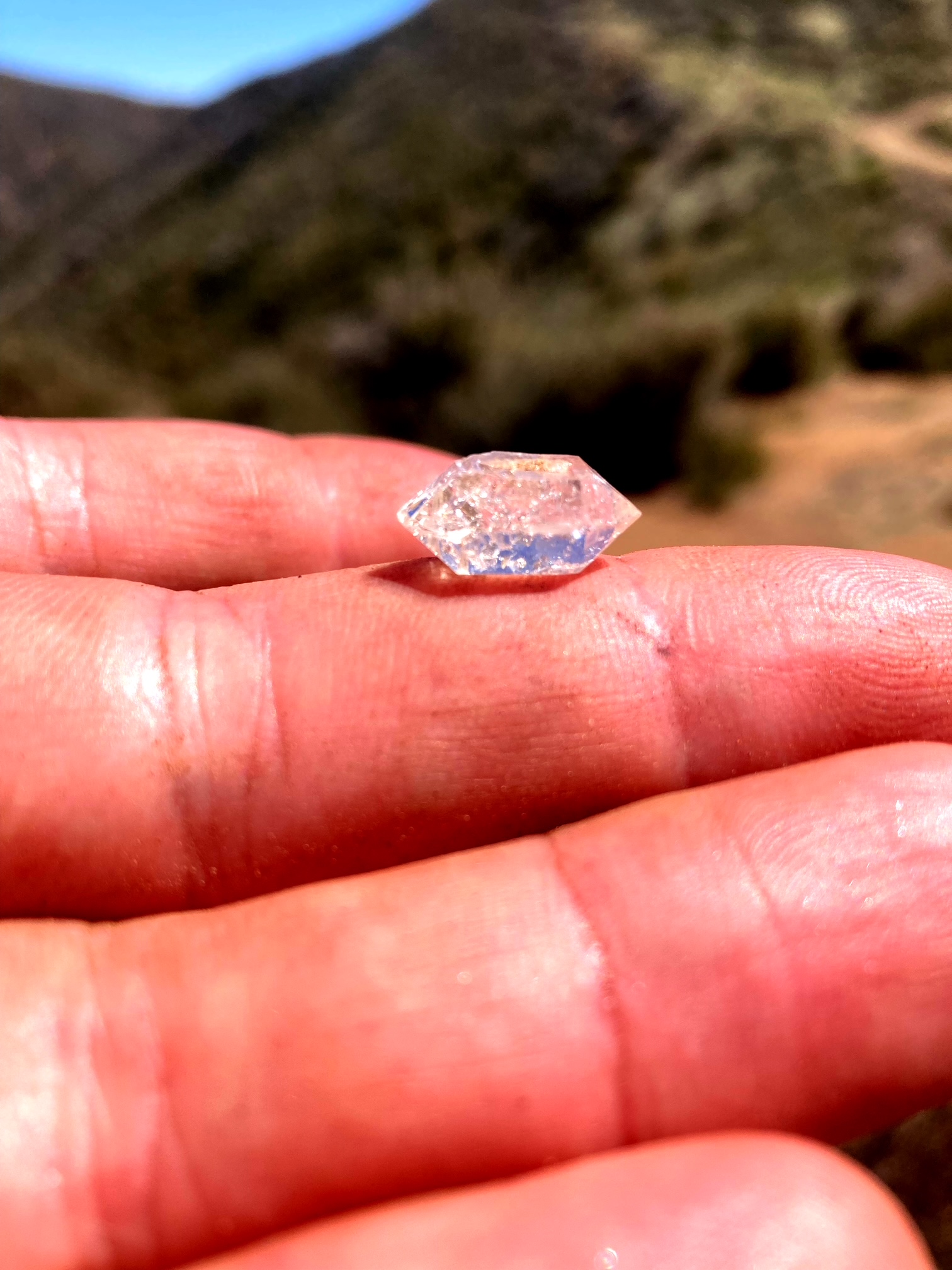
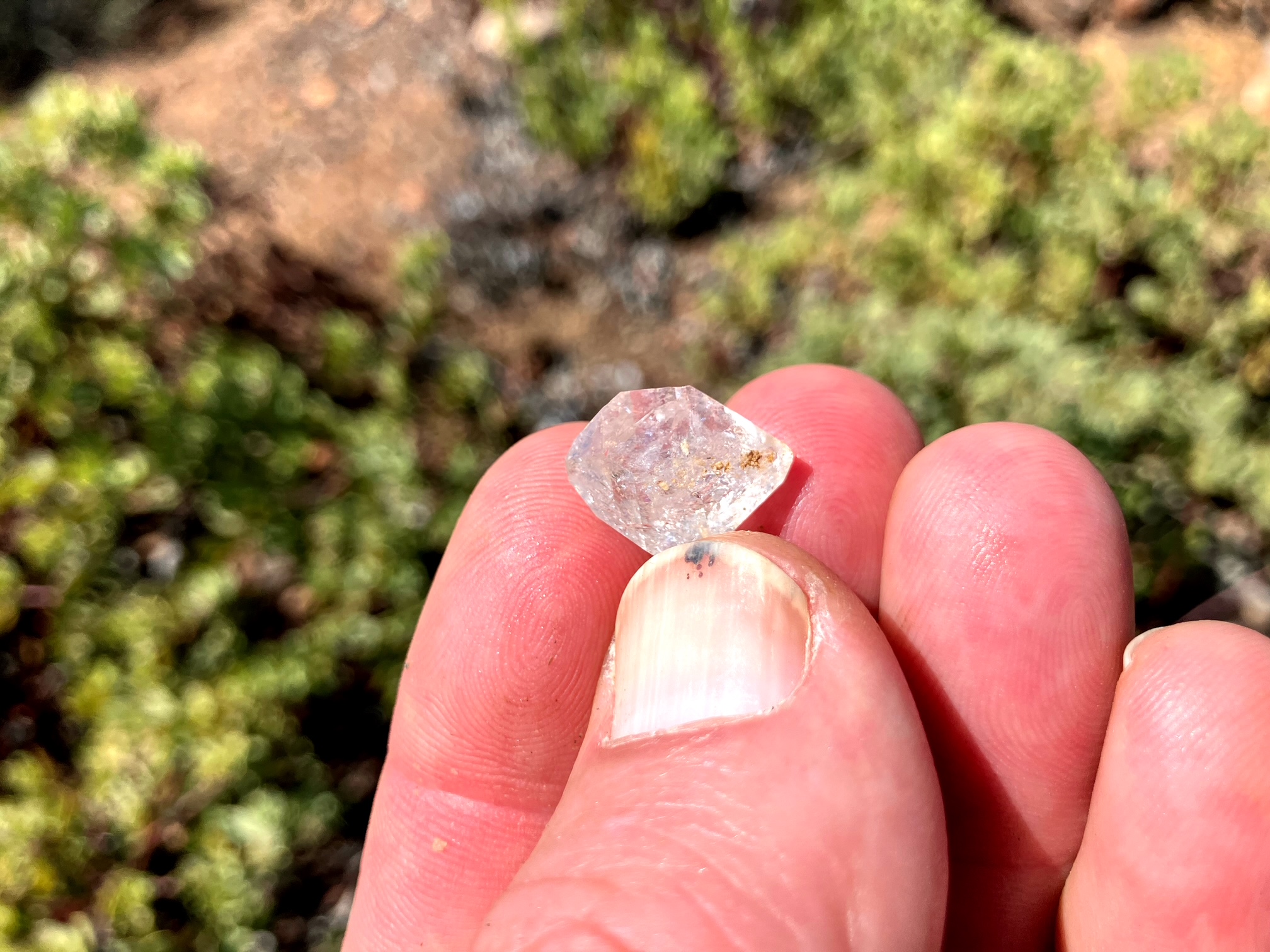 For most people, the slopes of Nordhoff Ridge look like little more than weathered sandstone, loose shale, and chaparral baked beneath the California sun. Hikers pass through them on their way to Chief Peak. Mountain bikers race over them, and trail runners barely glance at the rocks beneath their feet.
Greg Resnick sees something different.
He stops often. He kneels. He studies the ground with the practiced eye of someone who has spent decades learning how mountains reveal their secrets. Then, almost imperceptibly, a tiny flash might catch the light.
Occasionally, he will find a startlingly clear crystal no larger than the end of a finger. To Resnick, a geotechnical engineer and 30-year resident of Ojai and Ventura County, it is an “Ojai Diamond.”
It isn’t actually a diamond, of course. It is a small, doubly terminated quartz crystal — a rare geological curiosity that formed millions of years ago inside the ancient sediments that now make up much of Nordhoff Ridge and the Juncal Formation.
It is a diamond in the same sense as the famous Herkimer Diamonds in upstate New York, which are also doubly terminated quartz crystals. These crystals are also found in deposits in the Ouachita Mountains of Arkansas.
They are significantly more rare than actual diamonds. Diamonds, however, are hardened by hundreds of millions of years of geologic pressure. They are a 10 on the Mohs scale, which measures hardness, while the Ojai quartz “diamonds” are 7.5. By comparison, an emerald rates 7 and rubies at 9.
For more than thirty years, Resnick has quietly searched for these crystals in the mountains surrounding Ojai. He has found them beneath Topa Topa Bluff, on Sisar Canyon trails, along Pratt and Gridley routes, in the Matilija watershed, and on the climb toward Chief Peak. They appear most often after a rain washes away a layer of sediment, exposing new surfaces.
Yet despite their existence in one of Southern California’s most beloved hiking landscapes, remarkably few local residents have ever heard of them.
That may be changing.
“Back in the early to mid-1990s … I was riding by myself up to Nordhoff Ridge and there was a car parked there. And there were two people there, and they were walking around, intently looking at the ground,” he said. “I asked them what they were looking for, and they told me — doubly terminated quartz crystals.”
Resnick was hooked. Even with experience, though, it was rare to find the Ojai “diamonds,” perhaps as few as one in 50 or more quartz crystals “are actually a double terminate,” he said. “There is a lot of other secondary crystals up there.” He would ride with a group and it became part of the routine. “We’d spend ten, 15 minutes at the top of Sisar, and we’d be looking for them.”
Eventually, Resnick says, this practice “became kind of a meditation. Me and another engineer, we had these engineering brains that wouldn’t turn off. We got to a point where we would start spending an hour or two hours up there looking for them, and we started spreading out from Sisar and Nordhoff and started looking all along the road, and we started finding more.”
A Mountain That Was Once an Ocean
Nearly everything visible in the Ojai Valley was shaped by worlds that no longer exist.
The towering sandstone faces above the valley floor were once buried beneath an ancient sea. Long before the Topa Topas rose into the sky, fine sediments accumulated layer by layer on an ocean bottom. Over immense spans of time — 55 million years or more in the Eocene — those sediments hardened into rock before being uplifted, folded and fractured by the tremendous tectonic forces that continue to shape California today.
The Juncal Formation consists of sedimentary shales and sandstones that ranges from north of the Santa Ynez range to the Topa Topas, averaging about 3,300 feet in depth to more than a mile-thick near Romero Canyon.
Somewhere within that improbable sequence of events, tiny quartz crystals formed inside cavities within the sedimentary rock, called vugs.
These Ojai “diamonds” are unusual because they are doubly terminated — their crystal points developed freely on both ends rather than growing outward from a solid base.
To collectors, these formations are prized. To geologists, they tell a story about the conditions under which they formed.
Tony Thacher, farmer, lifelong resident and UC Berkeley-trained geologist, finds fascination in the creation of the Ojai Valley’s transverse ranges.
“We’re on a tiny sliver of land between Pacific and North American plates, which was subducted under the North American plate and moved north (from northern Baja-San Diego area),” he said. “Our two counties, Santa Barbara and Ventura, are like an irregularly shaped marble that rotated, as I tell people, from 8 o’clock to 12 o’clock, more than 90 degrees. Our transverse ranges, that’s why they run the wrong way.”
The Ojai Valley’s famous east-west orientation, which gives us maximum sun exposure and a spiritual context, is a result of this tectonic twist.
And the area is still being formed. “Ventura is rising faster than the Sierra Nevada even, going up by centimeters, up dozens of miles over millions of years,” Thacher said. “It keeps getting eroded of course. Still, with global warming and rising sea levels, we’ve got a fighting chance of keeping our beaches.”
Although similar crystals are famously associated with New York’s Herkimer Diamonds, comparable occurrences are uncommon, particularly within sedimentary formations like those surrounding Ojai. That rarity is one reason Resnick believes the crystals deserve greater recognition — not as a commercial treasure, but as another remarkable chapter in the valley’s natural history.
The Engineer Who Couldn’t Stop Looking
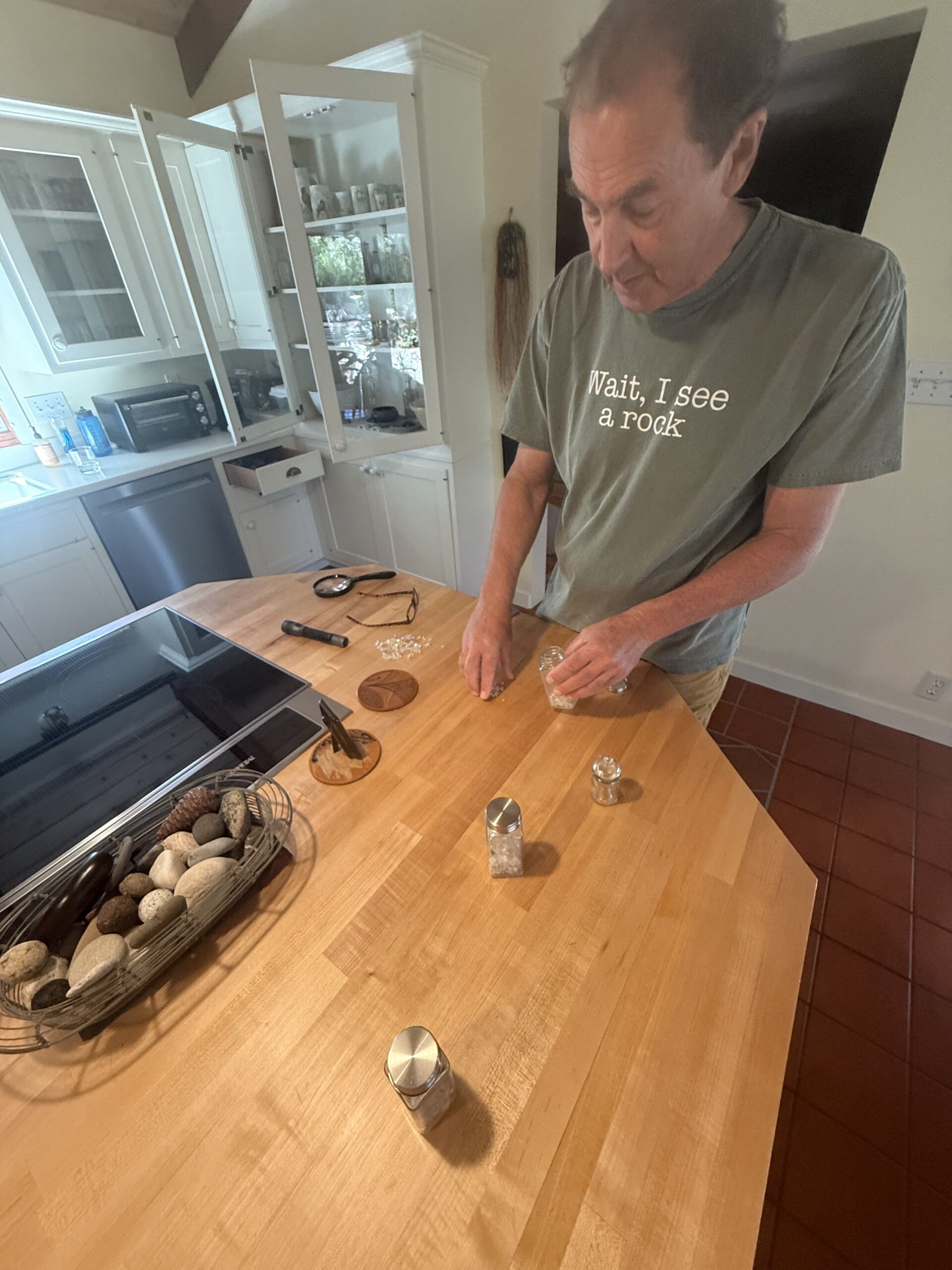
Greg Resnick with his collection of crystals, doubly-terminated quartz among them.
Resnick’s fascination with mountains began long before he ever arrived in Ojai.
Born in Point Loma, his childhood unfolded across an unusually varied landscape. His family moved frequently — Maui, Aspen, La Jolla, Reno, Boulder — before his education eventually led him into geological engineering.
He would later spend decades working as a geotechnical engineer in Ventura County. “I engineer the earth,” he explains simply. His profession revolved around foundations, landslides, earthquakes, groundwater, soil mechanics and the hidden forces beneath construction sites. Hotels, commercial buildings, roadways and major developments all depended upon understanding what lay below the surface.
While most people admired mountains from the outside, Resnick spent his career thinking about what existed underneath them.
It was almost inevitable that he would eventually become captivated by unusual rocks. He has an extensive collection of geological oddities, including fossils, petrified wood and varieties of crystals, including dozens of Ojai diamonds, ranging from the size of a grain of rice to a spark plug.
His interest in mountain biking only accelerated that curiosity. Hours spent exploring remote trails exposed him to formations that few people ever stopped to examine. Eventually he began noticing tiny quartz crystals weathering out of otherwise ordinary-looking rocks. One discovery led to another. Then another. Soon he was deliberately searching for them.
“The first ten years, it was very casual, as I was busy doing other things,” he said. Then he moved from Ventura to Ojai and bought an e-bike. “It was no longer a grueling two-hour mountain bike ride” to get to the diamond fields. “And now being retired I can really start looking.”
Unlike prospectors searching for something valuable, Resnick wasn’t motivated by money. He was captivated by discovery. Every crystal represented another clue — a tiny geological messenger carrying information across millions of years.
Hidden in Plain Sight
Perhaps the most surprising aspect of the story isn’t that these crystals exist. It’s that so few people know about them.
Ojai has earned an international reputation for natural beauty. Thousands of visitors climb toward Chief Peak each year. Countless hikers traverse Nordhoff Ridge, Pratt Trail, Gridley Trail, and the Matilija backcountry.
Most never notice what lies beneath their boots. Resnick believes that’s partly because the crystals are small, often hidden inside weathered rock, and require patience to recognize.
Once someone develops an eye for them, however, the landscape begins to change. The mountain seems to reveal another layer of itself.
Even people immersed in the world of crystals can find Ojai quartz remarkably elusive. Taylor Spoerlein, owner of Ojai’s Crystal Corner, says she has searched extensively around the Ojai Valley without finding any quartz crystals herself.
“I’ve found zebra jasper, but I haven’t found quartz yet,” she said.
She has, however, seen evidence that others are finding them. Spoerlein said people have come into the store to show her crystals they’ve found in Matilija Canyon. “Very tiny, 8 to 12 millimeters,” she said.
Someone else showed her smoky quartz found on Sulphur Mountain. But those who do find local quartz appear reluctant to part with it.
“They won’t sell,” she said. “They keep them for their private collection.”
There is also an ethical dimension. Like archaeological artifacts or wildflowers, these formations exist within a larger ecosystem.
Collectors have long debated how much should remain undisclosed in order to protect fragile locations from overuse.
Resnick himself spent decades saying little publicly about the crystals. Only recently has he begun considering whether the story deserves wider attention. “I don’t need to hoard everything. At some point I want other people to know about it. That means more eyes on it and lets more people enjoy it,” he said. “I only hope if they find some, they let me see it.”
Spoerlein finds that secrecy — and the sudden possibility that Ojai may have a crystal identity of its own — part of the appeal.
“I think it’s exciting and fun. Ojai isn’t known for crystals (hunting). I like that this is happening and that he’s kept it a secret … people come from all over looking for crystals from Ojai.”
Science Meets Wonder
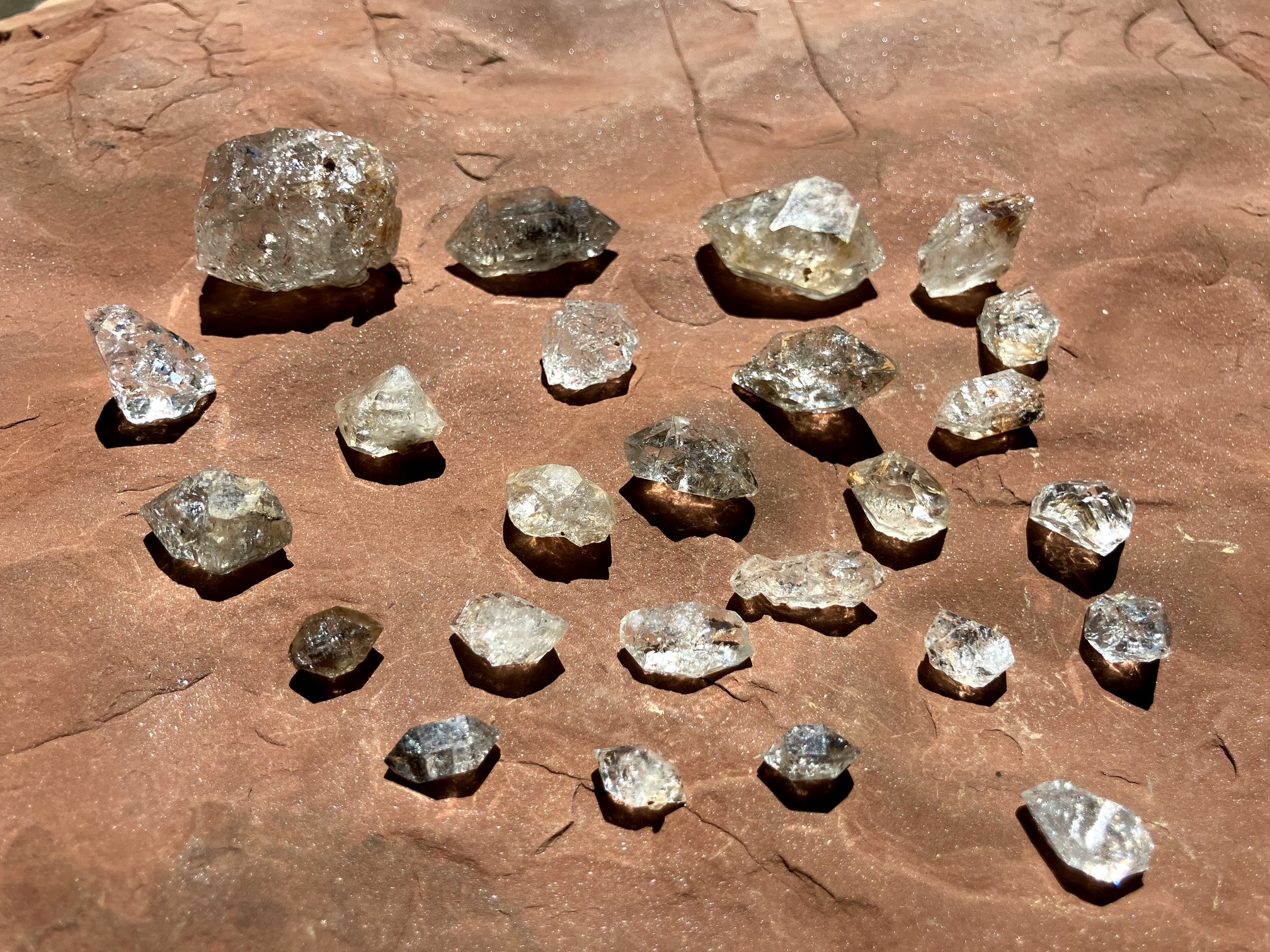
Variety of local doubly-terminated quartz crystals
In almost any other town, this would simply be a geology story. In Ojai, it inevitably becomes something more.
For generations the valley has attracted artists, mystics, scientists, philosophers and seekers of every description. It is a place where conversations about plate tectonics sometimes share the same coffee table as discussions of meditation retreats, sacred landscapes and invisible energy.
Crystals naturally occupy both worlds. To geologists they are elegant expressions of chemistry, temperature, pressure and time. To others they represent beauty, symbolism or spiritual meaning.
The two perspectives often coexist without requiring agreement.
For Spoerlein, the Ojai diamonds have particular significance because of the very characteristic that makes them geologically unusual: their points at both ends.
“Clear, double-terminated quartz crystals are energy generating. They are known as master crystals, amplifying energy.”
And for someone who works with crystals in a valley long associated with spiritual seeking and healing, the presence of the quartz suggests another intriguing connection.
Spoerlein believes these quartz deposits might “coincide with the shift in energy people feel when they come into the area.”
That stands to reason, she said. “You think of the technology in watches, for example. Quartz transmits and purifies energy.”
Resnick himself approaches the crystals primarily through the lens of science. His fascination lies in understanding how they formed and why they appear where they do.
Yet he also appreciates why others respond differently. There is something undeniably compelling about holding an object that began forming tens of millions of years before human beings walked the Earth.
Whether one sees geology, artistry or something more mysterious depends largely upon the observer.
Looking More Closely
Perhaps the greatest gift these small crystals offer has little to do with mineralogy. They encourage attention. Modern life rewards speed, while mountains reward patience.
To find one of these tiny quartz points requires slowing down enough to notice details most people overlook. The search itself becomes an exercise in observation.
That may explain why the story resonates beyond geology. Even lifelong residents occasionally discover that Ojai still contains surprises. Its familiar trails conceal unfamiliar histories, and its mountains still hold unanswered questions.
The rocks preserve stories written long before there was an Ojai Valley, long before Chief Peak became a landmark, long before hikers, mountain bikers or geologists ever climbed these slopes.
The crystals are simply one chapter in that much older narrative. They remind us that discovery is not reserved for distant expeditions or unexplored continents.
Sometimes it waits quietly beside a well-traveled trail. Sometimes it has been there all along. And sometimes all it takes is one person willing to stop, kneel, and look a little more closely.
Leave A Comment